Freshco Retail ltd
The Smartermarket That Cares
We want to bring your shopping bill down by giving you cheaper than Normal Tesco shelf prices not Including Clubcard or Reward Offers.
Starting with a small inventory & growing with our customer base, with your help using our community page you can let us know what your most needed & used products are.
We will be running a full years trial to see if this is a sustainable business model.
To make it sustainable we need you the customer to change your shopping habits, our pricing will be lower than a like for like shopping basket over Tesco normal shelf price & will definitely compete with other major retailers.
We do not sell fresh or frozen products at the moment.
WHY TESCO
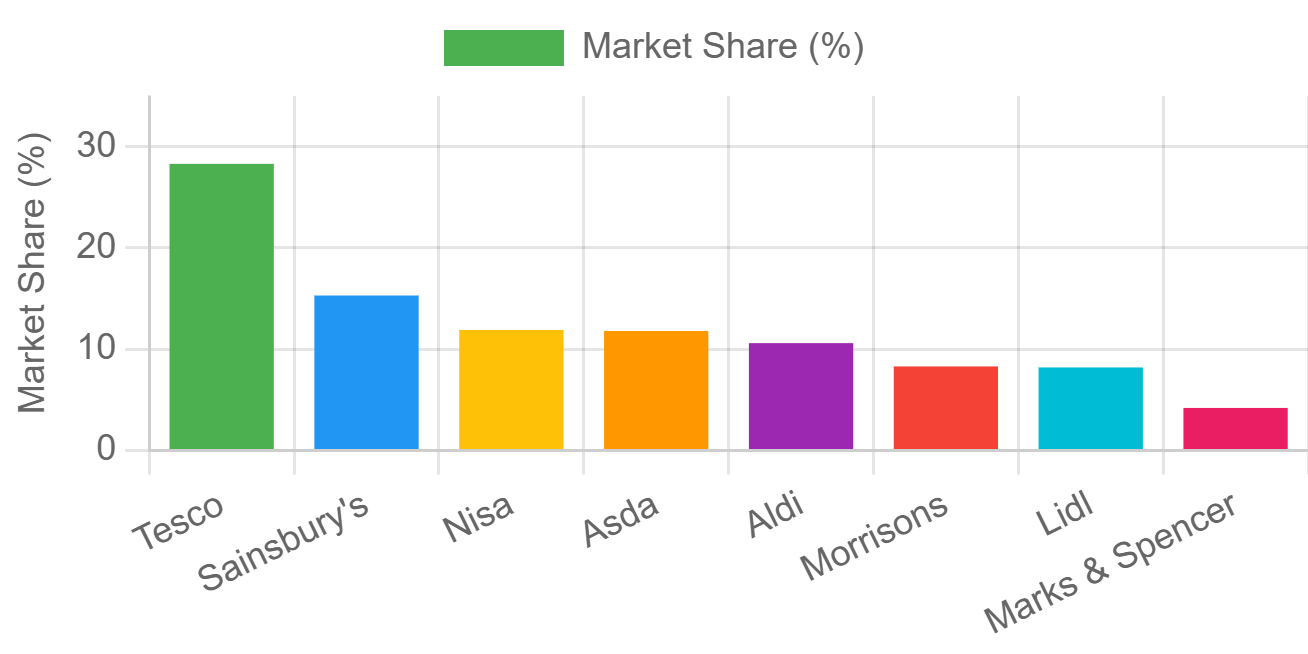
Tesco remains the dominant player in the UK grocery market, holding a 28.3% market share and an annual turnover exceeding £61billion as of 2026. Sainsbury's follows with 15.3%, Nisa with 11.9%, and Asda with 11.8%. However, the "Big Four" (Tesco, Sainsbury's, Asda, Morrisons) are facing increasing competition from discounters like Aldi and Lidl, who collectively command 18.8% of the market (Aldi 10.6%, Lidl 8.2%). These discounters are attracting shoppers with quality products at lower prices, leading to a shift in market share.
If a small self funded company can offer like for like products cheaper than the normal shelf price of the Biggest Supermarket in the U.K with all their buying power then logic would assume (In my Opinion) 1 of 4 things are happening,
1, Freshco has been lucky in buying these products at a price that is able to do this, but won’t be able to sustain this in the future & survive. But i don’t believe this.
2, Tesco has a huge markup on all it’s products more than the other Supermarkets would charge, as it seems overall more expensive comparing normal shelf prices.
3, Or Tesco has entered a phase of it’s business where it it essentially damaging it’s own profit margin by being the 1st supermarket to open an express store, followed by every other supermarket, which takes trade away from the main stores & essentially have changed the way people shop as the once a week bulk family shop has changed now (according to online static trends) to little & often, coupled with online shopping delivered to your door equals less people visiting main stores which are expensive to run forcing Tesco to charge higher than normal prices.
4, or your just being ripped of by
Tesco PLC, listed on the London Stock Exchange under the ticker TSCO, is now primarily owned by institutional investors, who collectively held 82% of the company's shares as of June 30, 2025. This broad ownership means that while no single entity has outright control, major decisions are influenced by a diverse group of shareholders. The largest single shareholder is BlackRock, Inc., holding 9.0% of outstanding shares as of the same date. Other significant institutional stakeholders include The Vanguard Group, Inc. with 5.30%, FIL Investment Advisors (UK) Ltd. at 3.508%, Norges Bank Investment Management with 3.366%, and BlackRock Fund Advisors at 2.928%. Collectively, the top 24 shareholders accounted for 51% of the company's ownership as of June 30, 2025, highlighting a dispersed ownership model that impacts corporate governance, director appointments, and executive compensation strategies. Understanding who owns Tesco is crucial for grasping its strategic direction and market positioning, especially for those interested in how to invest in Tesco shares.
Shareholder Percentage of Shares (as of June 30, 2025) BlackRock, Inc. 9.0% The Vanguard Group, Inc. 5.30% FIL Investment Advisors (UK) Ltd. 3.508% Norges Bank Investment Management 3.366% BlackRock Fund Advisors 2.928% Massachusetts Financial Services Company 2.89%.